
A Veteran’s Garden
A veteran starts building a community garden and finds healing in unexpected company

Author’s Note:
Thank you for taking the time to read this short story. This piece is part of a personal writing challenge this November: writing a short story every day based on prompts from my “Shift Notes - Resilience in Writing” focus, instead of tackling a novel.
While all my stories are fictional, this one sits close to the heart. If I could meet anyone from my family history, it would be my great-grandmother, Annie Merington. She was a true force of nature who married a returned serviceman from the Great War. Their life together was a special kind of love story: she was divorced with children, and he offered her a home and enough love for both of them.
The spark for this narrative came from my uncle, who always spoke about how Grandpa Merington instilled in him a deep love for gardening, cultivating both flowers and vegetables. This story is an exploration of that legacy. Of healing, belonging, and the quiet dignity found in working the land.
This story is dedicated to my great-grandparents, Dyson and Annie Merington.
Eric walked down Main Street, shifting his bag on his shoulder once again. Everything he loved and owned was tucked inside that old duffle, and he was painfully aware of how precious it all was.
He pulled out a folded piece of paper, checking the address and running his thumb along the worn creases. When he turned the corner, he knew he was in the right place.
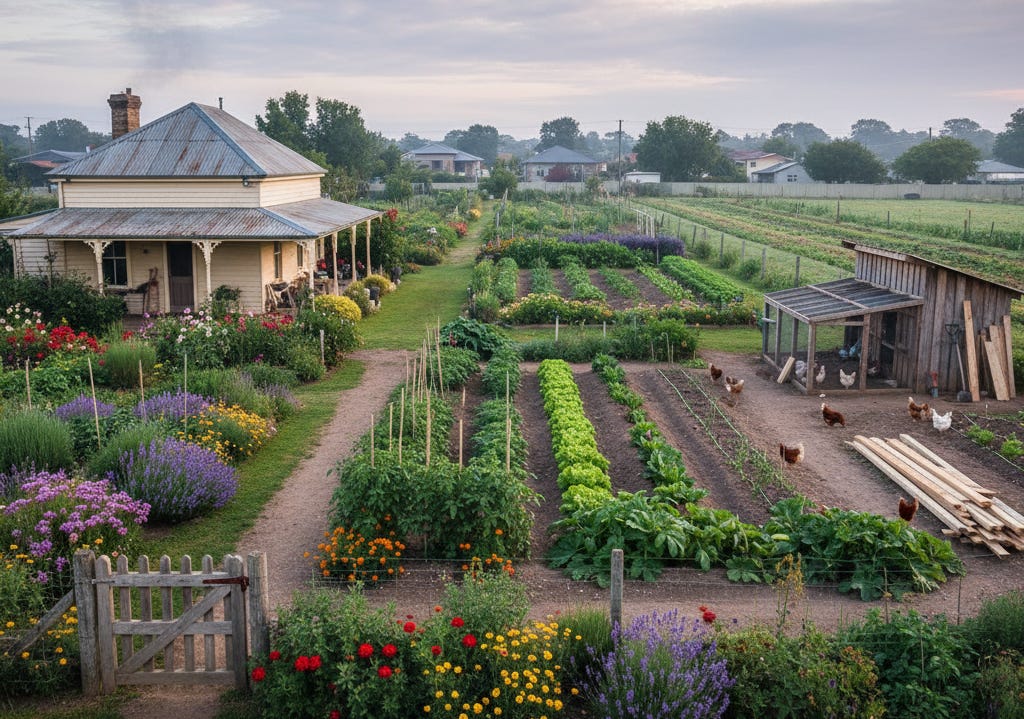
The property stood out in Sydney’s Inner West. Among the modest cottages lining the street, this land stretched over four acres. It looked out of place, almost rural against the suburban backdrop. You could almost forget you were in the Inner West if it wasn’t for the rumbling of the vehicles on the Main Street behind him.
A farmhouse sat in the front corner of the property, surrounded by a neat, colourful garden. Beyond that, rows of crops and garden beds spread across the land.
As Eric approached, two men working in the cool morning air noticed him. The older man said something to his companion before walking towards the fence.
“Eric Sullivan?”
Eric nodded and extended his hand over the wooden fence. “My Sergeant—”
“Yeah, he sent me your information. Said you needed a place?” The man looked Eric up and down. “I’m Dyson. That’s Henry.” He nodded towards the younger man still working.
“Sergeant Cooper mentioned you might be able to give me work?” Eric asked, trying to keep his voice steady. It had been hard finding a job since coming back.
“Yeah. You’ll help out around the property. It’s a bit of a community setup. Families nearby rely on us for vegetables and fruit. Sometimes they pay, sometimes they barter. I’ve got a bunkhouse out back with a few beds. You can share with Henry, if that’s alright?”
Eric nodded. He studied Dyson just as carefully. The older man’s left arm hung limp by his side, yet it didn’t seem to slow him down.
“I’ve got kids here. They’re my priority. No second chances, understand?”
Eric didn’t hesitate. He recognised that tone. “Yes, sir.”
“It’s not sir. I’m not your commanding officer. Call me Dyson. My wife’s Mrs Merrington. Understood?”
“Yes… Dyson.”
“Good.” Dyson’s expression softened slightly. “Dinner’s at six sharp. We start at six in the morning, finish at four. You’ve got two hours to yourself in the evening. I suggest you use it to read or study. There are books in the bunkhouse, and the library’s on Main Street. Sundays off. Sound acceptable?”
“Yes, Dyson.”
Dyson seemed satisfied. “Henry, come over.”
The younger man, about twenty-four or twenty-five, straightened and approached, he was still carrying the hoe that he had been working with, well cared for and oiled.
“Henry, take Eric to the bunkhouse, show him around, then go through the property with him once he’s settled.”
“Sure.” Henry smiled. “Welcome to Merrington Lodge.”
Eric shook his hand, shouldered his duffle, and followed him down the path. The old gate needed oil, Dyson mused, listening to it close behind them.
Dyson returned to the farmhouse. The screen door slammed behind him. A plump woman peeked out from the hallway, drying her hands on her apron.
“Eric Sullivan’s arrived,” Dyson said quietly.
“I’m sure he’ll work out. Bill said he’s a hard worker.” She handed him a glass of water. “I’m making stew tonight. Could you get me a few extra potatoes to stretch it?”
Dyson nodded, kissed her cheek, and stepped back outside.
For the rest of the day, he focused on the border plants that lined the crops—marigolds and basil, keeping pests away and helping the soil thrive.
Meanwhile, Henry and Eric settled into a rhythm, tending the rows of vegetables. As evening neared, Dyson walked by to check their progress. He paused when he heard their quiet conversation.
“How long were you in France?” Henry asked.
“It felt like a decade,” Eric said, wiping his brow. “In reality, five months.”
Dyson smiled faintly. Henry was a good listener. He always had been. Back when Dyson knew him as their unit’s chaplain, Henry had listened to more pain than most could bear.
“Did Mrs Merrington need extra potatoes for supper?” Henry asked suddenly, noticing Dyson nearby.
“Yes, she did.”
Henry crouched, dug up a few potatoes, and dropped them into a basket. He handed them to Dyson.
“Thanks. See you both at six,” Dyson said, heading back to the farmhouse.
Henry and Eric packed up their tools. “Best get cleaned up. Mrs Merrington likes us to look presentable.”
Eric grinned. “Has Dyson ever thought about chickens? There’s space for a coop.” He looked over to the bare corner of the large property.
“Maybe. I think they’ve talked about it, but nothing’s happened yet. You’ve worked with chickens before?”
“Yeah. We had some in France, then in Italy.” Eric chuckled. “Had a mascot once.”
“What happened to it?”
“Christmas dinner.”
Henry laughed. “You named it, didn’t you?”
“Agnes.” They both burst out laughing.
The next day, the three worked in companionable silence. When tea break came, Eric looked at Dyson.
“I could help build a chicken coop. Eggs would be good for your wife, and maybe we could breed them later for roasts.”
Dyson considered, biting into his biscuit, the familiar sweetness with oats and coconut reminded him of the war. “Let’s see what we can find. You’d build it yourself?”
“Yes, Dyson.”
Within months, the farm had changed. The clucking of hens became part of its rhythm. Dyson had dropped his guard around Eric, and the three men worked side by side with quiet trust.
One morning, Henry cleared his throat. “There’s room in the bunkhouse for another man, if we need the help.”
“I’ve been thinking the same,” Dyson said, cigarette dangling from his lips, an old habit from his service days.
“Maybe reach out to Cooper? Eric’s really found himself here. Talking, working, feeling useful. Maybe there’s another veteran who needs the same chance.”
Dyson watched him carefully. “You’re the one doing the real heavy lifting with that. You sure you want to keep it up?”
Henry smiled faintly. “I lost too many I couldn’t help. Here, I can. This is where I’m meant to be. Not back at the church. Working the land, helping others heal.”
Dyson nodded slowly. “I’ll write to Cooper today.” He paused before heading inside. “Thank you, Henry.”