
I don’t know
A doctor learns to say "I don't know", and it changes how they practice medicine

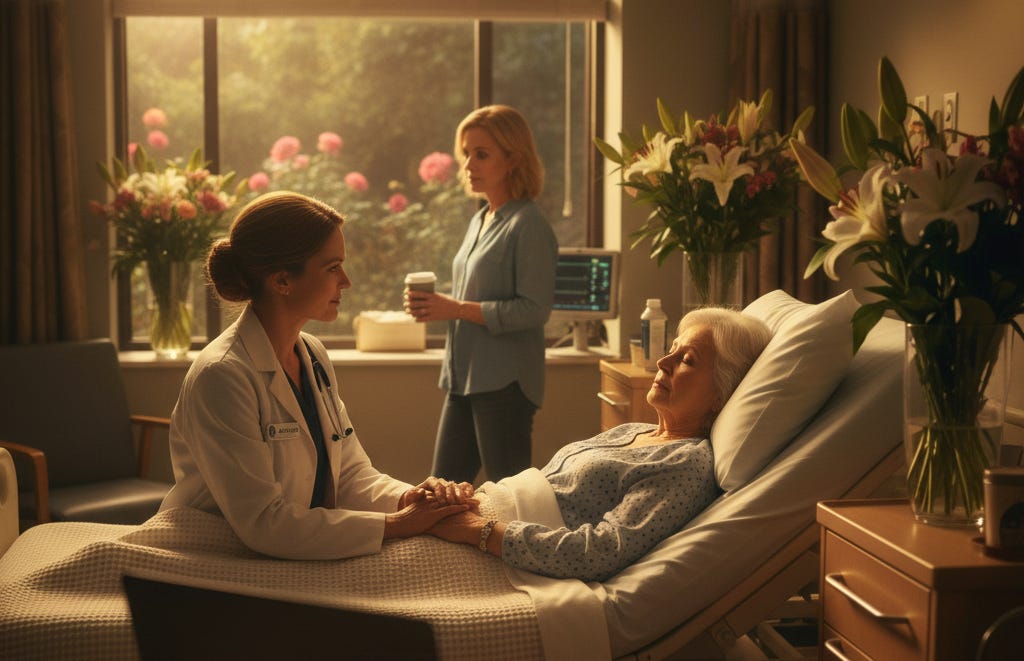
Walking the pristine floors of the surgical ward, my shoes squeaked with every step. These days, the squeak was more a comfort than an annoyance.
The beeping of the heart monitor in the first room became my breathing rhythm. The elderly woman lay sleeping, the waffle-patterned blanket tucked tightly around her chest, keeping her warm. Her arms rested by her sides. I gently touched her cool hand and checked her pulse.
A throat cleared behind me, pulling me from the moment.
“What’s her prognosis?” The voice was calm, detached. The woman stood in the doorway, looking past me at the sleeping patient.
“Who are you?” I kept my tone even.
“Her daughter.” She looked tired. Shadows under her eyes spoke of long nights and little sleep. Her brow carried the weight of old worry lines.
“I’m Doctor—”
“I don’t care for your name. This is just another hospital, and you’re just another medical professional who’ll tell me nothing except empty condolences.” She leaned against the doorframe, waving off my introduction.
I pulled out the chart and scanned the board. Mrs O’Hara. 79. Pneumonia.
“Mrs O’Hara’s pneumonia is resolving, though she’s still frail. Her oxygen levels are stable, and her vitals are within normal limits for her condition. We’ll continue antibiotics for another forty-eight hours and maintain fluids. Her decline remains advanced. No change. She’s not in distress.”
“And she’ll go back to the nursing home?” Her sigh was long, exhausted.
“Yes. If her recovery continues, she can be discharged back to the facility within a few days. Her prognosis is poor long-term, given her age and dementia stage, but there’s nothing acute.” I replaced the file.
“Thank you. I’ll… go get another coffee then.” She hitched her handbag higher on her shoulder and walked away.
I looked back at the elderly woman, then moved on to the next room.
The next patient was a middle-aged woman watching television, her magazine open in her lap.
“Ms Farrier.” I announced myself as I walked in.
She glanced up, nodded once, and returned to her magazine. The television hummed as background noise. Comfortable pajamas, freshly washed hair. She’d been here long enough to settle in. Her hair was barely an inch long, shaved recently.
I checked her vitals and chart. “Any questions or problems?”
“Yeah. When can I get out of here?” She snorted, not looking up as she flipped a page with more force than necessary.
“We’ll review your vitals tomorrow and revisit your rehabilitation—”
“Save it. You need more information.” She rolled her eyes and turned her back to me. I was dismissed.
I shrugged and left the room.
The next room smelled faintly of lilies and money. High-end bouquets filled the space, each in a glass vase that cost more than I made in a week.
The woman in the bed sat cross-legged, laptop balanced on a tray table surrounded by folders and paperwork.
“Good afternoon, Doctor.” Her voice was bright. “The nurses just finished with my vitals, you’ll see them on my chart.” She nodded toward the end of the bed, where it still swung slightly from being rehung.
“Thank you.” I glanced at the board. “Ms Shaw.”
“Sam is fine.” She returned to her laptop. “Any word on when I can leave?”
I paused, scanning the data. Her vitals were neatly written, Fiona’s handwriting, always precise. The room was quiet, the only background sound was the soft lo-fi music from her laptop. No beeping, no alarms.
“Everything looks fine,” I said, frowning, closing the chart looking at her information on the board. Who was her on-call doctor? “We’ll review the labs tomorrow and reassess—”
“Stop.” She sighed, then smiled. It wasn’t unkind, just sharp. “You look like someone who gives patients the bare minimum, thinking it’s enough to get through the day. You’ve lost your bedside manner. You think it makes people comfortable, but really, it makes them trust you less.”
I blinked. “I’m sorry?” The words caught. It had been a long time since anyone had seen through me.
She leaned forward, chin resting on her hand, elbow on the table. She closed her laptop and studied me, choosing her words carefully.
“You see how many patients on this floor every day? You put them into neat boxes, reducing them to vitals and charts. It helps you cope. But does it really help them?” Her eyes softened. “I get it. You don’t have all the answers. Neither do I. I run money for people in a world that changes by the hour. I work with projections, not promises…just like you. Want to know the best advice I ever got?”
I swallowed. “Go on.”
“It’s okay to say: I don’t know. But then you add: let me find out and get back to you.” She gave me time to absorb it. “People prefer honesty and accuracy over confidence and mistakes. It builds trust. It builds rapport.”
I stayed quiet.
“Maybe start listening beyond the words and the questions. Sometimes the thing they’re asking isn’t the thing they really want answered.” Her smile softened the lesson.
There was no flourish. Just truth.
She continued, “I know I’m not out of here until after my surgery. I was trying to keep things light. The easy patient. But I know my prognosis. I know tomorrow’s surgery will tell us more about my brain cancer, and I’ll be here a while. Then we’ll decide the next steps.”
I exhaled. “I didn’t realize I’d become…” The word failed me.
“It’s okay. I know people. I know what they need to hear. Sometimes it’s comfort, sometimes bluntness. So, Doctor…?”
“Hanover. Julia Hanover.”
“Dr Hanover.” She smiled faintly. “I suppose you’re our ward doctor for the next few days. I’ll see you on your next round.”
I nodded and turned to leave. “Thank you, Ms Shaw.”
“Sam,” she corrected gently.
I glanced back. She smiled. “Jules,” I said with a nod.
It took me longer to finish my rounds that night. I didn’t mind.
When I returned to Mrs O’Hara’s room, her daughter stood by the window, a paper coffee cup in her hands still. The view wasn’t much, but it overlooked the rose garden below.
I checked Mrs O’Hara’s pulse again, her hands still cool to the touch. This time, I held her hand a little longer.
Clearing my throat, I said, “I’ve seen pneumonia patients like your mother recover within a few days. We’ll keep her another twenty-four hours after that to make sure she’s stable before she returns to Rosehaven.”
“You know where she’s staying?” Her daughter turned to me, shocked.
“Yes. I checked in with the nursing facility. They’ve had a few patients with flu-like symptoms. I sent some notes about your mother’s case to their on-call doctor to review.” I surprised even myself by calling him and discussing Mrs O’Hara’s case.
“Thank you.” Her sigh was lighter this time. “I appreciate that.”
“I’m Dr. Julia Hanover.”
“Maureen Chandler.”
“Maureen, can I ask… how are you? You look exhausted. I’m worried you’re not looking after yourself.”
For the first time in a long while, I realized my patients needed more than vitals and charts.
They needed empathy.
They needed care.
And, maybe so did I.